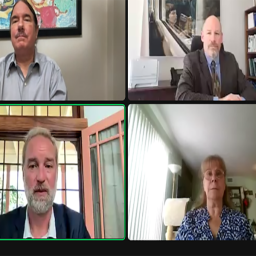

A group of investors who entrusted their savings to former stockbroker Sara Goldring is seeking to hold two US financial firms accountable for losses estimated at US$16 million.
In an arbitration claim obtained by El País, the investors allege that Jefferies and Pershing allowed Goldring to conduct high-risk transactions in accounts opened in their clients’ names. According to Uruguayan lawyer Patricia Regules, the group currently comprises 22 investors.
On Friday, November 6, the US lawyers working with Regules, Dan Cetner and Jason Kane, filed the claim with the US Financial Industry Regulatory Authority ( FINRA ). They are seeking to recover lost capital and collect punitive damages, interest, and the fees they attribute to the disputed transactions.
The document leaves the total amount to be determined in arbitration. Kane and Centner, partners at the Peiffer Wolf law firm, traveled to Montevideo this week to meet with those affected and deliver letters to government agencies.
The dispute centers on the obligations assumed by the two firms when dealing with Goldring’s companies. In 2017, Jefferies agreed to receive clients referred by Custodia de Valores Mobiliarios (CVM) and United Brokers. Pershing acted as the settlement agent for these transactions. Investors who held accounts in their names are involved in this arbitration.
This is an ongoing legal process in the United States against the two financial institutions, and it does not involve Goldring. Some of the investors in this group signed the Private Reorganization Agreement (PRA), which stipulated that they waived their right to make further claims against the now convicted company, which has already begun paying 60% of the recognized debts.
The forms that arrived after the signing
The document obtained by El País recounts the case of two clients who, in June 2019, informed a Jefferies employee via email that they had already signed an agreement to trade options at CVM’s offices in Uruguay. Only after signing had they received warnings about the risks of these investments, in documents Jefferies sent them in English. According to the exchange cited in the complaint, the employee explained that they should have received this information before signing and asked them to sign again.
Three weeks later, CVM’s compliance officer sent Jefferies a form attributing 19 years of investment experience to the clients, including options trading. The investors maintain that this information was false—they did not have 19 years of experience, they say. And they allege that Jefferies enabled the account for options trading even though the form lacked the approval signatures of its own officers.
[…]
In a letter dated November 9 addressed to the Legal Services Manager of the League for Commercial Defense ( Lideco ), the lawyers proposed representing the company in a second arbitration. To estimate how much it could claim, they requested access to the records of those accounts.
The firm offered to advance the expenses and charge 33% of any recovered sum, before deducting costs, which would also be reimbursed from that money. Furthermore, they assured that any proceeds would be deposited into CVM’s liquidation fund for distribution.
On Monday, during a luncheon of the Marketing Executives Association, the president of the Central Bank, Guillermo Tolosa, was asked if the organization was willing to “explore ways to recover money in the United States.”
Tolosa referred to the agreement with creditors in Uruguay and said that with it, “the legal avenue for further recovery is waived,” although he did not specify whether this waiver included a potential lawsuit by CVM against the US firms. The lawyers maintain in their letter that the brokerage retains that right.
[…]
The signed debt restructuring agreement stipulates that creditors will be paid 60% of their verified claims. Separately, on October 27, the Uruguayan criminal court convicted Goldring of misappropriation after he admitted to using client funds to cover losses for others. Following this conviction, the lawyers representing a large group of victims (Ignacio Durán, Ana Irabedra, Eduardo Sassón, and Pablo Donánngelo) expressed their satisfaction with the work of the Money Laundering Prosecutor’s Office, headed by Enrique Rodríguez.
During the sentencing hearing, a tense moment arose when Regules argued that the agreement was inadmissible because it did not meet the legal requirements and stated that, if accepted, the seized assets should not be released.
Prosecutor Rodríguez responded that when he filed the original charges, a settlement offer like the one that had been reached did not yet exist. Therefore, he argued that the new situation had to be taken into account when determining the compensation. The prosecutor also stated that those who did not accept the agreement retain the right to pursue a civil claim.
Attorney Eduardo Sasson emphasized the complexity of the investigation and argued that the criminal case “does not resolve all the issues.” He also stated that a criminal precautionary measure could not be maintained after sentencing and that it was necessary to analyze what measures could be requested in a civil proceeding.
Pablo Donnángelo added that the Prosecutor’s Office had summoned the victims’ representatives to a meeting prior to the agreement and stated that at that meeting he had heard Regules congratulate the prosecution team for the negotiation.
Source: El Pais Uruguay November 11, 2026